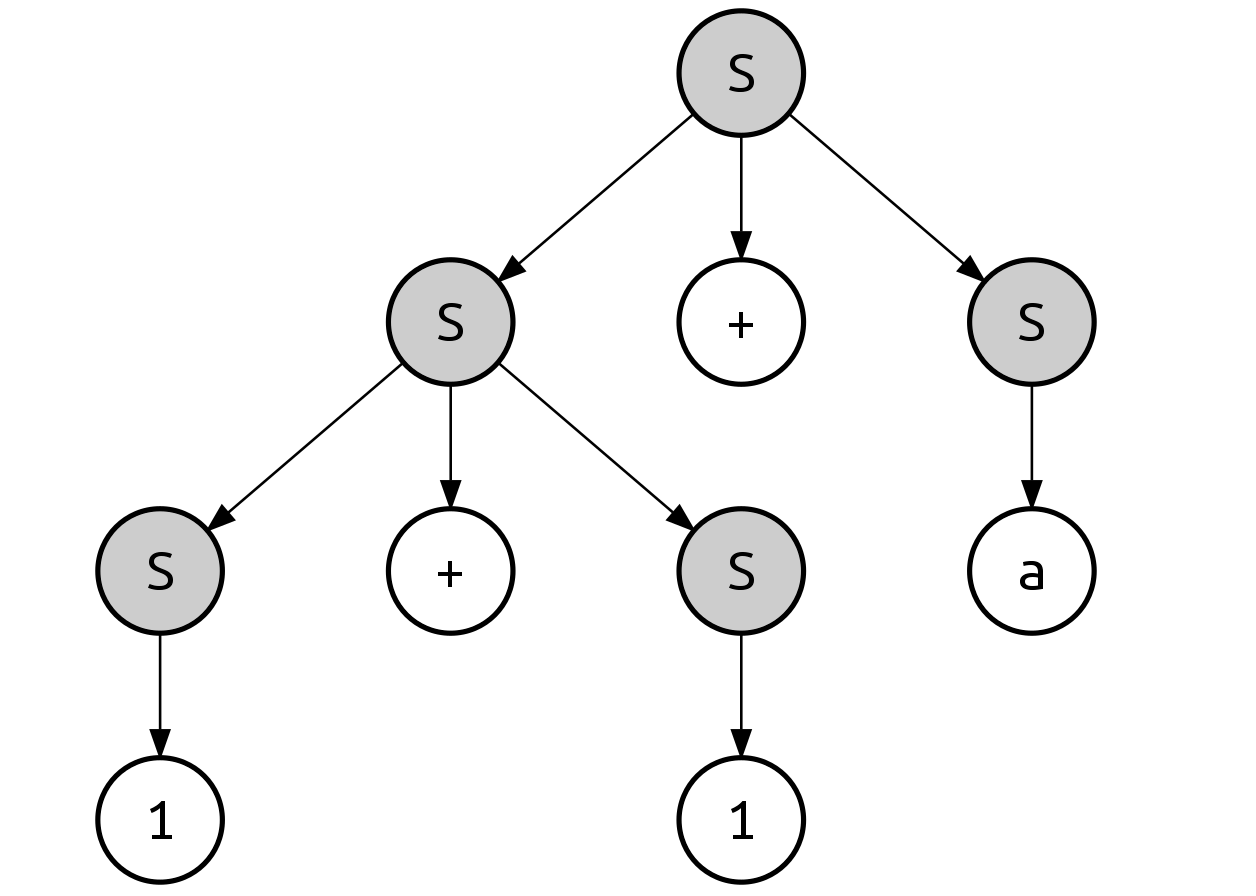
A derivation of a string for a grammar is a sequence of production rule applications.
The process of getting the string through the derivation is the parsing process.
For example, with the following grammar:
S → S + S        (1)
S → 1            (2)
S → a            (3)
The string \(1 + 1 + a\) can be derived from the start symbol \(S\) using 2 types of derivations: leftmost derivation and rightmost derivation.
Leftmost Derivation
In the leftmost derivation, the nonterminals are applied from left to right. Initially, we can apply rule 1 on the initial \(S\):
Next, the leftmost \(S\) can be applied with rule 2:
The next nonterminal is the second \(S\). If we apply any of rule 2 or 3, there are still underived characters in the input string, so we choose rule 1 instead:
Now, with the remaining characters from the input, we can apply rule 2 on the first \(S\):
Finally, the last \(S\) can be applied with rule 3:
The above derivation can be represented as the following parse tree:
Rightmost Derivation
In the rightmost derivation, the nonterminals are applied from right to left.
Initially, we can apply rule 1 on the initial \(S\):
This time, we apply rule 1 on the rightmost \(S\):
We found that rule 3 can be applied to the rightmost \(S\):
Next, we can apply rule 2:
And finally, rule 2 can be applied again:
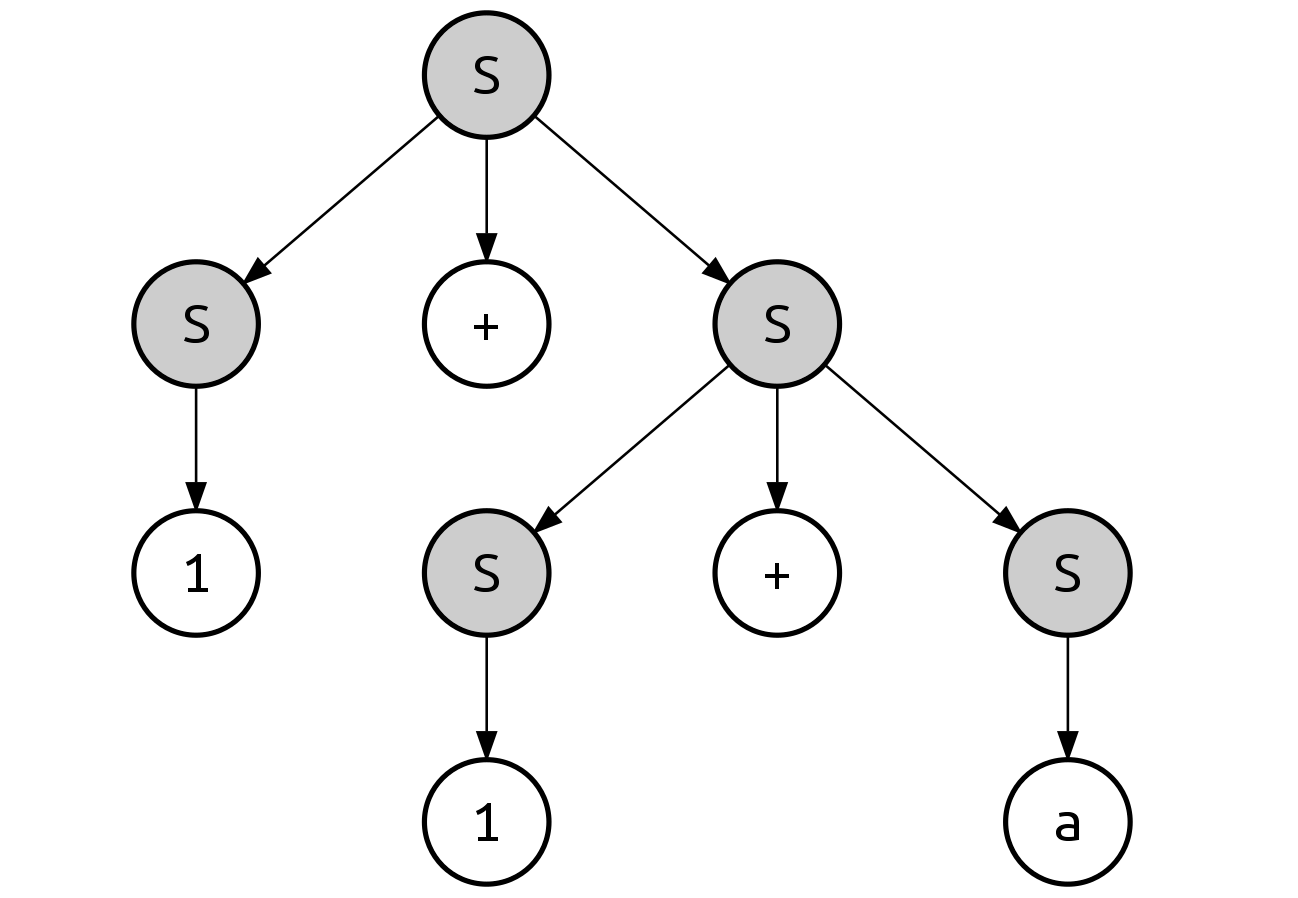
This derivation can be represented as the following parse tree: