In mathematics, the fundamental theorem of arithmetic states that: “Any integer number larger than 1 can be written as a product of prime numbers in one and only one way”.
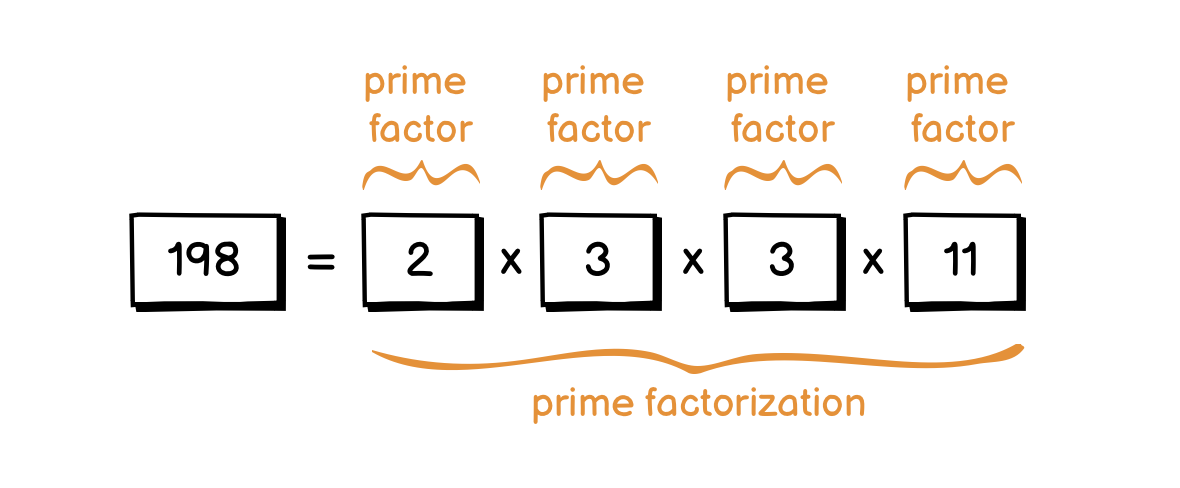
No matter how you come up with the prime factorization, the set of prime factors might have a different order, but they are always the same set.
In algorithm problem solving, the uniqueness of a prime factorization can be applied in some situations, for example, to check if two strings are made up from the same set of characters, with a different arrangement (anagram).
The idea to solve this kind of problem is, to map the characters in each string to a prime number:
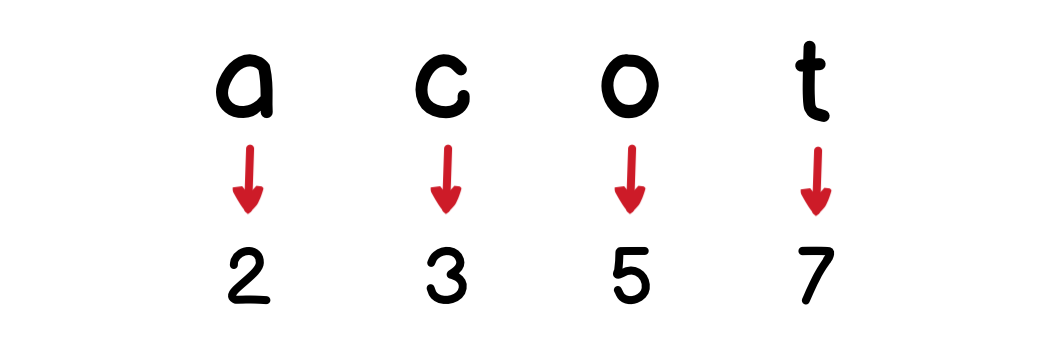
Then multiply them together, if they made up the same integer number, then they’re anagram.
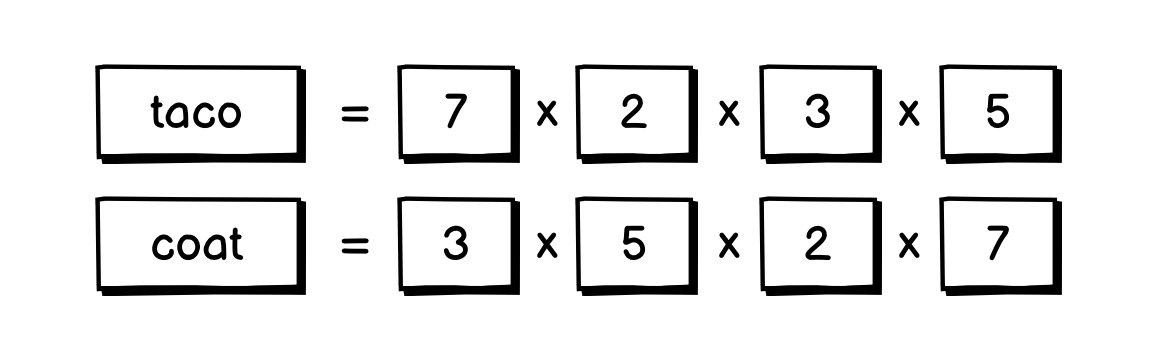
The proof of the uniqueness can be found on Page 16, Section 2 of the Elementary Number Theory: Second Edition book. But Wikipedia has a great summarization:
Suppose we have an integer \(n\) that has two distinct prime factorizations \(n = p_1 \times p_2 \times p_3 \times \cdots \times p_j\) and \(n = q_1 \times q_2 \times q_3 \times \cdots \times q_k\), where each \(p_i\) and \(q_i\) is a prime.
We see that \(p_1\) divides \(n\), so \(p_1\) divides \(q_1 \times q_2 \times q_3 \times \cdots \times q_k\). By Euclid’s lemma, we have that \(p_1\) divides some \(q_i\), let’s say \(q_1\).
Since \(p_1\) and \(q_1\) are both prime, they must be the same, so \(p_1 = q_1\). Cancel both \(p_1\) and \(q_1\) from the two prime factorizations, we get:
Continue the process, eventually, we will find that each \(p\) is a \(q\). After each cancellation, we cannot run out of \(p\) before all the \(q\) are gone. This means, \(p_1 \times p_2 \times p_3 \times \cdots \times p_j\) are just a rearrangement of \(q_1 \times q_2 \times q_3 \times \cdots \times q_k\). The two factorizations are just differ in the order of the factors.